
The short answer
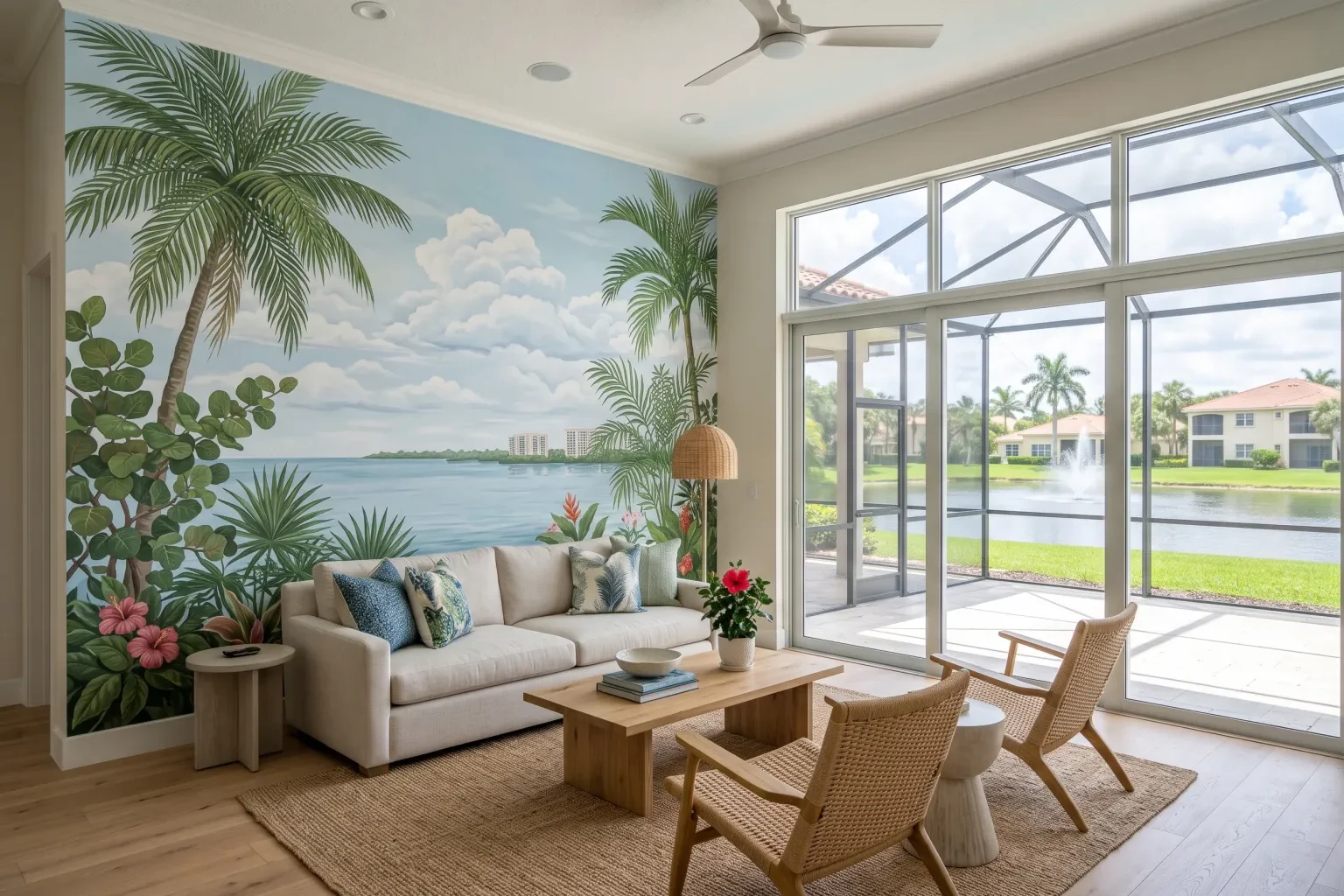
Murals work best on one uninterrupted wall that becomes the focal point of a room, such as behind a bed, a dining table or in a nursery. Success depends on a flat primed surface, a plumb starting line, and panels hung in their numbered order with the image aligned across every seam.
A wall mural is one large image split into numbered panels, and the whole picture only works if every panel lands exactly where the designer intended. A palm canopy that drifts half an inch at the third panel, or a horizon line that tilts toward the corner, is obvious from across the room. WallEdge Installation puts up printed murals in houses, townhomes and condos across Boynton Beach and neighboring towns in Palm Beach County. Below we cover which rooms suit a mural, how the wall gets prepared, the sequence we follow on install day, the factors that change the scope of a job, and simple upkeep once the image is on the wall.
Is a mural right for your space?
Think of a mural as artwork rather than background. It pulls the eye, so it belongs on the wall people face when they walk in or sit down. Headboard walls, the end wall of a dining area, a reading nook, a child's room and a home theater are common choices.
The best candidate is a wide stretch with few interruptions. Every window, door, thermostat or switch cuts a hole in the picture. A wall broken by a big slider usually reads better with a repeating pattern instead, because the cutouts are less noticeable.
Scale is the other question. A tropical leaf print that looks lovely in a catalog can feel crowded in a small guest room, while a soft landscape can open up a narrow condo hallway. Before you order, send us the wall dimensions and the mural file, and we will tell you whether the image will be cropped and where.
Preparing and priming the wall
Because a mural is one continuous image, flaws behind it are easier to spot than behind a busy pattern. We fill dents, sand patched areas flush and knock down heavy orange-peel or popcorn-style texture where it would show. Glossy paint gets scuffed or treated so paste can grip.
In many older Boynton Beach ranch homes, interior walls are plaster over concrete block. That surface is hard and durable but can hold hairline cracks and pockets of moisture. We check for damp spots and let any repairs cure fully.
Then the whole wall gets a wallcovering primer suited to the mural material, whether that is paper, non-woven or vinyl. Primer evens out absorption so the print does not show patchy shine, and it gives you a clean release when you want a new look years from now.
Install day: the order we work in
Most murals ship with an overlap allowance, called bleed, around the outside edges. That margin is what lets us correct for walls and ceilings that are not perfectly square, which describes most houses. Here is how the day typically goes.
- Lay out the panels on the floor in order and confirm the full image is there, undamaged and printed correctly.
- Measure the wall in several places and decide how the bleed is split between top, bottom and sides so key details like a horizon or a face are not cut off.
- Snap a plumb line with a laser for the first panel instead of trusting the corner, which is rarely straight.
- Paste the wall or panel according to the material, then hang panel one and check it against the line.
- Hang each following panel, matching the image across the seam first, then pressing the edge tight; some vinyl murals call for a slight overlap and double cut.
- Trim the bleed at ceiling, baseboard and side walls with a straightedge and sharp blade, and cut neatly around outlets with the power off.
- Wipe excess paste from the face and trim and step back to check the alignment from the room's main viewpoints.
Factors that change the scope of a mural job
Two murals of the same size can take very different amounts of time to hang. When we put together a quote, we look at the following.
- Condition of the wall and how much patching, sanding or texture removal it needs.
- Mural material, since heavy vinyl, thin paper and self-adhesive panels each need different handling.
- How the image matches across panels, and whether fine details like lettering or faces land on a seam.
- Overall wall area, ceiling height and whether ladders or scaffolding are needed.
- Number of cutouts for windows, vents, outlets and built-in shelves.
Keeping the mural looking sharp
Let the paste cure for a few days before hanging frames or pushing furniture against the wall. During that time, keep the room cooled and dry; South Florida summers bring heavy humidity and afternoon storms, and steady AC helps the seams set tight.
Most printed murals can be wiped lightly with a damp, soft cloth. Check the product label first, because paper murals are more delicate than vinyl. Avoid harsh cleaners or abrasive pads, which can lift ink. Direct sun through west-facing windows can fade inks gradually, so sheer curtains or UV film are worth considering.
Small nicks happen, especially in hallways and kids' rooms. Keep a leftover strip or the trimmed bleed rolled up in a closet rather than tossing it. Because a mural is a single printed image, a damaged section usually cannot be bought again later, but a matching offcut can sometimes patch a corner or the area behind a dresser. If a seam opens or a panel corner lifts after a heavy storm season, let us know and we can re-seat it with seam adhesive before dust collects under the edge and makes the repair harder to hide.
Mural Installation by city
- Mural Installation in Ocean Ridge
- Mural Installation in Briny Breezes
- Mural Installation in Hypoluxo
- Mural Installation in Manalapan
- Mural Installation in Gulf Stream
- Mural Installation in Lantana
- Mural Installation in South Palm Beach
- Mural Installation in Atlantis
- Mural Installation in Delray Beach
- Mural Installation in Lake Worth Beach
- Mural Installation in Greenacres
- Mural Installation in Lake Clarke Shores