
The short answer
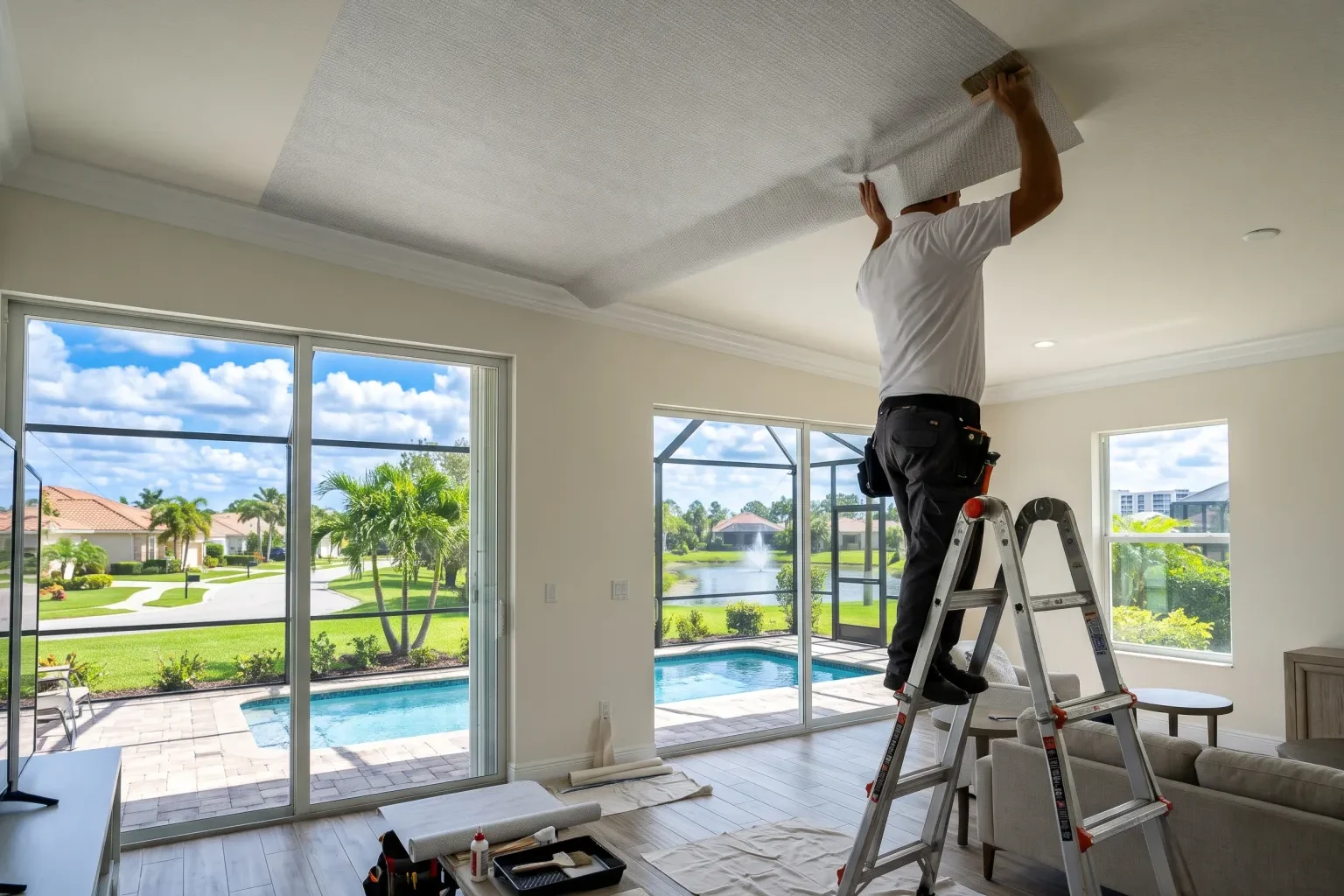
Ceiling wallpaper suits rooms with a defined ceiling plane, like tray ceilings, powder rooms, bedrooms and dining rooms. We remove texture, prime, lay out strips from the room's visual center and hang lightweight or prepasted papers from a stable platform.
Ceilings are the largest blank surface in most rooms, and in a lot of South Florida houses they are also the most ignored: flat white, maybe popcorn texture, a fan in the middle. Papering overhead turns that plane into part of the design. A soft grasscloth over a primary bedroom, a small geometric in a powder room, a tray ceiling lined in metallic paper, or a sky-toned mural above a nursery all work because people look up more than they expect. Overhead hanging is also some of the hardest wallcovering work there is. Every strip fights gravity, the installer works from planks or a scaffold, and light from windows and fixtures rakes across the surface and exposes every ridge. WallEdge Installation papers ceilings across Boynton Beach, Hypoluxo, Ocean Ridge, Greenacres and nearby towns, and below we lay out how we judge a ceiling, prepare it, hang it and leave it ready to live with.
Rooms where papering overhead pays off
Some ceilings practically ask for it. Tray and coffered ceilings already have a frame, so paper inside the recess reads as intentional. Small rooms such as powder baths, laundry rooms and walk-in closets get a lot of personality from a modest amount of material. Dining rooms with a chandelier benefit from a pattern that radiates from the fixture.
We are more cautious in full bathrooms with showers, kitchens over the range, and lanai-adjacent rooms where sliding doors stay open in summer, because steam and outdoor humidity attack the adhesive from below. A vinyl or a moisture-tolerant product, strong exhaust ventilation and steady air conditioning are the conditions we look for before recommending paper in those spaces. Vaulted and sloped ceilings can be papered too, but the seam layout needs more planning where planes meet.
Preparing a ceiling so paper stays put
Acoustic popcorn texture, common in older ranch homes around Palm Beach County, has to come off first. Before scraping, the homeowner should have the texture tested for asbestos if the house is old enough to raise the question; we will not disturb a ceiling that has not been cleared. After removal the drywall is usually rough, with torn paper face and tape lines, so it gets a skim coat, sanding and a second inspection under a work light.
Smooth ceilings still need attention. We look for hairline cracks along tape joints, nail pops, and yellow or brown rings that point to an old roof or AC condensate leak. Stains get sealed with a stain-blocking primer so they do not bleed through light paper. Then a wallcovering primer goes over the whole field. On a ceiling, primer does more than help adhesion: it gives the paper a little slip so we can slide each strip into position before it grabs.
The fixtures come down or get loosened. Ceiling fans, light canopies, smoke detectors and AC supply grilles are removed or dropped so paper can run underneath and be trimmed cleanly around the openings. If electrical work is needed beyond loosening a canopy, that is a job for your electrician before we arrive.
Our sequence for hanging a ceiling
Planning matters more overhead than on walls, because the first strip sets every line that follows and nobody wants a pattern that runs crooked relative to the room. We usually decide strip direction by the longest dimension and the main light source, so seams run toward the window and cast less shadow.
Next comes layout. We snap a chalk or laser reference line off the center of the room or the main fixture rather than off a wall, since walls in many block-construction homes are slightly out of square. The pattern is planned so the motif lands symmetrically around the light or fan, and any partial strips fall at the edges where crown molding or the wall line hides them.
Strips are cut with allowance for the drop match and for trimming at both ends. Pasted lengths are folded accordion style, which lets one installer hold the bulk while feeding the paper onto the ceiling a section at a time. We work from planks or a rolling scaffold set at a comfortable height, smoothing from the center outward to push air toward the edges.
Seams are butted and gently set with a seam roller. Excess at the wall line or inside the tray is trimmed with a broad knife and a sharp blade, which we change constantly because a dull edge tears damp paper. Openings for fixtures are cut in an X, then trimmed to the canopy outline. Finally, paste residue is wiped off the face and off adjoining walls and crown before it dries.
Factors that drive the effort and the quote
No two ceilings are priced alike. After a site visit we write up the scope based on these points.
- Starting surface: popcorn removal, skim coating and stain sealing can take longer than the hanging itself.
- Height and access: a standard eight-foot bedroom ceiling is a very different setup from a vaulted living room that needs scaffolding.
- Paper weight and type: lightweight prepasted and nonwoven papers are friendlier overhead; heavy grasscloth, fabric or hand-printed papers need extra hands and time.
- Repeat and match: large repeats and drop matches add waste and slow the layout around fixtures.
- Shape of the ceiling: trays, beams, soffits, skylights and sloped planes each add cutting and fitting.
- Number of penetrations: recessed cans, vents, fans and detectors each need individual trimming.
Caring for a papered ceiling
Overhead paper sees far less wear than wall paper, so care is mostly about the environment. Run the bathroom exhaust fan during and after showers, keep the AC running through the humid months, and avoid shutting the house up without cooling for long stretches while you travel in summer. If a hurricane or storm leads to a roof leak, address it quickly, because water above a papered ceiling shows up as staining and loosened seams.
Dust occasionally with a long-handled soft duster. Avoid ladders and wet sponges on delicate papers; for washable vinyl, a lightly damp cloth is fine. Keep a spare roll from the same run tucked away in a dry closet in case a section ever needs replacing.